

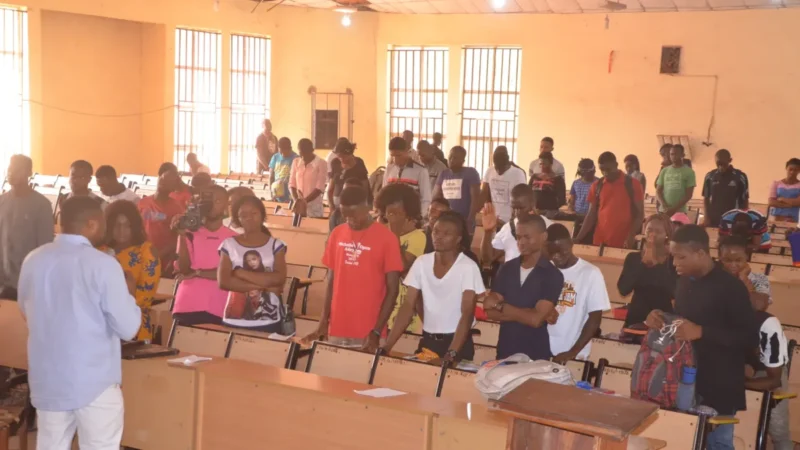
For Nigerian professionals looking for a fully funded master’s degree in development-related fields, the JJ/WBGSP Scholarship is one of the opportunities worth preparing for early. The Joint Japan/World Bank Graduate Scholarship Program is the full name of the scheme. The 2027 cycle is already scheduled, Nigeria is on the eligible-country list, and the programme has published the universities and master’s courses that will participate.
This is not a scholarship where you submit one general form and wait for a university placement. You first need admission to an approved master’s programme, and the participating university must shortlist you as an eligible scholarship candidate. That makes the admission stage just as important as the scholarship application itself.
For the 2027 cycle, the World Bank has announced two application windows: 18 January to 26 February 2027, and 29 March to 21 May 2027. The exact window you use depends on the participating programme you are applying to.

JJ/WBGSP Scholarship 2027: Quick Facts
| Item | Details |
|---|---|
| Scholarship | Joint Japan/World Bank Graduate Scholarship Program |
| Study level | Master’s degree |
| Nigerians eligible? | Yes. Nigeria is on the 2027 eligible-country list. |
| Study areas | Development-related master’s programmes selected by the World Bank |
| Participating programmes | 44 master’s programmes at 24 universities for the 2027 cycle |
| Window 1 | 18 January to 26 February 2027 |
| Window 2 | 29 March to 21 May 2027 |
| Funding | Tuition, basic medical insurance, living allowance, round-trip economy airfare and travel allowance |
| Application route | Admission to a participating programme first, followed by university shortlisting and the JJ/WBGSP scholarship application |
What is the Joint Japan/World Bank Graduate Scholarship Program?
The JJ/WBGSP is a graduate scholarship funded by the Government of Japan and administered through the World Bank’s scholarship programme. It supports professionals from eligible developing countries who want to study a development-related master’s programme and return to contribute to development in their home countries.
The 2027 programme includes 44 participating master’s programmes at 24 universities across the United States, Europe, Africa, Oceania and Japan. The available courses cover areas such as public policy, development economics, global health, climate change, environmental management, taxation, infrastructure and other development-related subjects.
The important point for Nigerian applicants is that you cannot choose any master’s degree and then ask JJ/WBGSP to fund it. The scholarship is tied to the participating programmes published for the relevant application window.
Are Nigerians eligible for JJ/WBGSP 2027?
Yes. Nigeria is specifically listed among the countries eligible for the 2027 JJ/WBGSP scholarship for developing-country nationals.
Being Nigerian is only one part of the eligibility test. The programme also applies professional, academic, admission and other conditions that must be met together.
JJ/WBGSP 2027 eligibility requirements
The World Bank says applicants from developing countries must meet the detailed requirements in the application guidelines. The main conditions for the 2027 cycle include the following:
- You must be a national of a World Bank member developing country included on the 2027 eligible-country list.
- You must not hold dual citizenship of a developed country.
- You must be in good health.
- You must hold a bachelor’s degree or equivalent university degree earned at least three years before the relevant scholarship application deadline.
- You must be employed in development-related work in a paid full-time position when you submit the scholarship application.
- You must have at least three years of paid development-related employment after earning your bachelor’s degree, with the qualifying experience falling within the six years before the application deadline.
- You must be admitted unconditionally, except for funding, to at least one participating master’s programme for the upcoming academic year.
- The participating programme must be outside your country of citizenship and country of residence listed when the call opens.
- You must not be a World Bank Group Executive Director, alternate or staff member, or a close relative of someone covered by that restriction.
The professional experience requirement is particularly important. This is aimed at people who already have development-related work experience, rather than applicants coming directly from a bachelor’s degree into postgraduate study.
The World Bank also makes clear that its eligibility rules are applied strictly. Applicants should therefore check the current guidelines for their specific application window instead of relying on requirements from an older scholarship cycle.
What counts as development-related work?
JJ/WBGSP is designed around development-related professional experience. Relevant work can span different sectors, so applicants should not assume that only economists or employees of international development organisations qualify.
The World Bank’s guidance gives development-related topics that can help applicants judge whether their professional background fits. Examples include economic policy, public administration, health, education, infrastructure, environmental management, agriculture, social development and related areas.
If your work contributes to public policy, economic or social development, service delivery, institutional development, infrastructure or another recognised development area, compare your actual responsibilities with the current programme guidance rather than relying only on your job title.
What does the JJ/WBGSP scholarship cover?
The scholarship provides substantial financial support for the approved master’s programme. The current World Bank benefits include:
- Tuition for the graduate programme.
- Basic medical insurance obtained through the university.
- A monthly subsistence allowance for living expenses, including accommodation, food and books. The amount varies according to the host country.
- Economy-class air travel between your home country and the host university at the beginning of the programme and after the scholarship period.
- A US$600 travel allowance for each of the two supported trips.
The scholarship normally covers the duration of the graduate programme or two years, whichever is shorter.
There are also important exclusions. JJ/WBGSP does not normally cover visa costs, expenses for family members, additional travel during the programme, computers, extra-curricular courses, research-related expenses, field trips, internships, supplementary educational materials or residence permit fees.
If you already have another scholarship or fellowship, the JJ/WBGSP award cannot simply duplicate that funding. The World Bank requires recipients to disclose other financial support.
Which universities offer JJ/WBGSP programmes in 2027?
The 2027 participating programmes are divided between two application windows. This matters because the university and course you choose determine when you need to be ready for the scholarship stage.
Window 1 programmes
Window 1 runs from 18 January to 26 February 2027. The participating institutions include:
- Brandeis University, with master’s programmes in areas including global sustainability policy and management, global health policy and management, and public policy.
- Columbia University, including MPA programmes in economic policy management and global leadership.
- Johns Hopkins University, Master of Public Health.
- KIT Royal Tropical Institute and Vrije Universiteit Amsterdam, MS in Public Health and Health Equity.
- University of California, Berkeley, Master of Development Practice.
- University of Tsukuba, Master’s Program in Economic and Public Policy.
- Williams College, Master of Arts in Policy Economics.
- Yale University, Master in Systemic Risk.
Window 2 programmes
Window 2 runs from 29 March to 21 May 2027. It includes programmes at institutions such as Australian National University, Columbia University, Erasmus University, IHE Delft, Keio University, London School of Economics and Political Science, GRIPS, Saitama University, SOAS University of London, Stanford University, University of Leeds, University of Oxford, University of Tokyo and Yokohama National University.
Examples include master’s programmes in climate change, environmental management and development, public policy, development studies, global health policy, sustainable cities, water and sustainable development, development economics, international policy, agriculture development studies and infrastructure management.
Do not assume that every master’s course at one of these universities qualifies. The scholarship applies to the specific programmes listed by the World Bank for the 2027 cycle.
When is the JJ/WBGSP 2027 deadline?
There are two scholarship application windows:
- Window 1: 18 January to 26 February 2027.
- Window 2: 29 March to 21 May 2027.
These are scholarship application dates, not necessarily the admission deadlines for the universities. A university may require your admission application much earlier so that it can assess and shortlist candidates before the JJ/WBGSP scholarship window closes.
For that reason, Nigerian applicants should not wait until January 2027 to begin. If your target programme is in Window 1, admission preparation should already be underway before the end of 2026.
How to apply for JJ/WBGSP 2027 from Nigeria
The process is different from scholarships that accept a direct application from anyone interested in studying abroad.
1. Choose a participating programme
Start with the official 2027 list of participating master’s programmes. Check the course content, admission requirements, application deadline and whether the programme is in Window 1 or Window 2.
2. Apply to the university
Apply for admission directly to the university offering your chosen JJ/WBGSP programme. Your admission application may require academic transcripts, references, a statement of purpose, CV, proof of English proficiency or other documents depending on the institution.
3. Secure unconditional admission
For JJ/WBGSP, the admission letter must be unconditional except for funding. The World Bank requires the admission letter to be uploaded with the scholarship application.
4. Check whether the university will shortlist you
The JJ/WBGSP scholarship application link is not simply an open public form for every applicant. The World Bank says the link is communicated to candidates who have been admitted unconditionally, except for funding, and shortlisted as eligible JJ/WBGSP applicants by the participating university.
This makes your university application and your communication with the programme important. Ask the relevant admissions or programme office how it handles JJ/WBGSP candidates and whether there are additional internal steps for scholarship consideration.
5. Prepare the scholarship application
Once you are eligible and invited to apply, prepare the scholarship application carefully. Your professional record, recommendations, commitment to your home country and academic background are central to the assessment.
6. Submit before the correct window closes
Submit through the official JJ/WBGSP process for your application window. Do not assume that a university admission application automatically becomes a scholarship application.
How JJ/WBGSP applications are assessed
The World Bank says eligible scholarship applications are independently reviewed by two qualified assessors. The assessment gives the greatest weight to four areas:
- Quality of professional experience: 30%.
- Quality of professional recommendations: 30%.
- Quality of commitment to your home country: 30%.
- Quality of education background: 10%.
The programme also considers geographical and gender distribution, unusual circumstances or hardship, and applicants’ access to financial resources for graduate study abroad.
This tells you something useful about preparation. A strong JJ/WBGSP application is not simply an academic application with a scholarship paragraph added at the end. Your work history, references and evidence of how you plan to use the degree in Nigeria or your wider development work need to tell a coherent story.
Documents to prepare for JJ/WBGSP
The exact document list can depend on the participating university and the scholarship application window, so applicants should use the current World Bank guidelines as the final checklist. In practice, you should expect to work with documents such as:
- International passport or acceptable proof of nationality.
- Bachelor’s degree certificate or equivalent qualification.
- Academic transcripts.
- CV showing your professional history.
- Evidence of development-related employment.
- Professional recommendation letters.
- University admission letter showing unconditional admission except for funding.
- Scholarship application information and supporting statements.
- Any additional documents requested by your chosen university or the current JJ/WBGSP application guidelines.
Start collecting these documents before the scholarship window opens. Reference letters and university admission decisions can take time, and waiting for one missing document can put an otherwise strong application at risk.
What should Nigerians know before applying?
You need professional experience
This is not a general postgraduate scholarship for recent graduates without relevant work experience. The programme requires at least three years of qualifying paid development-related employment after your bachelor’s degree.
Admission comes before the scholarship application
One of the biggest mistakes is treating JJ/WBGSP like a normal scholarship portal. You need admission to a participating programme and university shortlisting before you can proceed to the scholarship application.
The university deadline may come first
A scholarship deadline of February or May does not mean you can wait until that month to apply for admission. Check each university’s own deadline and allow enough time for an admission decision.
Do not use old programme lists
Participating programmes can change from one cycle to another. Always use the World Bank’s current 2027 programme list when deciding what to study.
You are expected to return and contribute
JJ/WBGSP scholars from developing countries commit to return to their home country after completing the degree and use their new skills to support social and economic development.
How to improve your JJ/WBGSP application
Start with the development problem you want to work on rather than beginning with the scholarship itself. Explain what you have already done, what gap remains in your skills, why the chosen master’s programme is a logical next step and how the training will improve your work after graduation.
Your professional recommendations should add evidence rather than repeat your CV. Choose people who can discuss your work, leadership, technical ability, development impact and potential.
Also take the university admission application seriously. Since the scholarship route depends on admission and university shortlisting, a weak or rushed university application can prevent you from reaching the scholarship stage at all.
For more practical preparation, see our guides on how to apply for a scholarship, scholarship application documents and how to write a scholarship personal statement.
Official JJ/WBGSP application and information
The safest place to confirm the 2027 rules, participating programmes, application windows and scholarship application process is the World Bank’s official JJ/WBGSP page:
World Bank JJ/WBGSP official page
Applicants should also check the official 2027 eligible-country list, the Window 1 programme list and the Window 2 programme list before applying.
Frequently asked questions
Can Nigerian students apply for JJ/WBGSP?
Yes. Nigeria is included in the World Bank’s official list of countries eligible for the 2027 JJ/WBGSP scholarship for developing-country nationals. Applicants must still meet all other eligibility requirements.
Is JJ/WBGSP fully funded?
It provides major funding including tuition, basic medical insurance, a monthly living allowance, round-trip economy airfare and a US$600 travel allowance for each supported trip. Some costs, including visa fees, family expenses, computers and research-related expenses, are excluded.
Can I apply for any master’s degree?
No. You must be admitted to one of the specific participating master’s programmes listed for the 2027 cycle.
Do I need work experience?
Yes. The 2027 eligibility requirements include at least three years of paid development-related employment after your bachelor’s degree, with qualifying experience acquired within the six years before the relevant application deadline.
Can I apply for JJ/WBGSP before getting university admission?
No. The scholarship process requires unconditional admission, except for funding, to a participating master’s programme by the scholarship application deadline. The participating university must also shortlist you as an eligible JJ/WBGSP candidate.
When should Nigerians start preparing?
Start well before the scholarship windows. For a Window 1 programme, admission and scholarship preparation should be underway before January 2027. For Window 2, do not wait until March to begin university admission work.
Do I have to return to Nigeria after the scholarship?
Developing-country scholars commit to return to their home country after earning the degree and use their skills to contribute to social and economic development.
Related scholarships
If JJ/WBGSP does not fit your background or preferred course, you can also explore our guides to DAAD EPOS Scholarships, Erasmus Mundus Scholarships, Australia Awards Scholarships and the Scholarships & Funding hub.
Last checked: 7 October 2026. Scholarship windows, participating programmes and eligibility rules can change between cycles, so confirm the official World Bank information before submitting an application.
 Scholarships & Funding
Fully Funded Scholarship Checklist: Costs Nigerian Students Must Confirm Before Accepting
 Scholarships & Funding
Chevening Scholarships 2027/2028 for Nigerians: Eligibility, Benefits and How to Apply
 Scholarships & Funding
Student Venture Capital Grant in Nigeria: How Student Founders Can Prepare
 Scholarships & Funding
Mastercard Foundation Scholarships for Nigerian Students: Eligibility, Benefits and How to Apply
 Scholarships & Funding
Commonwealth Scholarships 2027/2028 for Nigerians: Eligibility, Benefits and How to Apply
 Scholarships & Funding
Commonwealth Scholarships 2027/2028 for Nigerians: How the Nomination Process Works
 Scholarships & Funding
DAAD EPOS Scholarships 2027/2028 for Nigerians: Eligibility, Benefits and How to Apply
 Scholarships & Funding
MEXT Scholarship 2027 for Nigerians: Eligibility, Benefits and How to Apply
 Scholarships & Funding
Erasmus Mundus Scholarships 2027 for Nigerian Students: Eligibility, Benefits and How to Apply
 Scholarships & Funding
Federal Government Scholarship Awards: Revised Amounts and How Students Can Verify Eligibility
