


A strong scholarship personal statement should explain why you are applying, what you have done, what you want to achieve and why the scholarship fits your plans. The best statements do not simply repeat a CV. They use specific experiences to show your motivation, strengths and goals.
There is no single personal statement that works for every scholarship. Some providers give detailed questions, while others ask for a general statement. Read the current application instructions first, then shape your answer around what the provider wants to learn about you.
Start with the scholarship question
Before writing, copy the exact question into a separate document. Break it into smaller parts and make sure you answer each one.
For example, a question may ask about your leadership experience, your career plans or how the scholarship will help you create impact. These are different tasks. A statement that spends most of its space describing your childhood may not answer the actual question.
Chevening, for example, asks applicants to respond to specific essay questions covering leadership, relationship-building, their chosen course and future career plans. Its guidance also tells applicants to observe the word limits and tailor their answers to the questions. Check the current Chevening application guidance.
Choose experiences that prove your point
Do not begin by trying to sound impressive. Start by finding two or three experiences that show something important about you.
Your examples could come from work, volunteering, school, university, community activities, research, a project or another genuine responsibility. Choose examples that connect directly to the question.
For each example, ask yourself:
- What was happening?
- What was my responsibility?
- What action did I take?
- What changed because of my actions?
- What did I learn?
- How does this experience connect to my next goal?
This approach gives the reader evidence rather than a list of claims.
Show what you did, not only what you believe
Statements such as “I am a natural leader” or “I am passionate about education” are easy to write. They are also difficult for a reader to assess without evidence.
Instead, describe a real situation. Explain the problem, your role, the action you took and the result. Then explain what the experience taught you.
Chevening's application advice makes a similar point. Its reading committees recommend using relevant examples from your own experience and showing how you used particular skills to achieve something positive. It also recommends giving more detail to one or two strong examples instead of listing many achievements without substance. See Chevening's application advice.
Use your own voice
A scholarship personal statement should sound like you. Avoid phrases that you would never use in normal writing simply because they appear formal.
For example, instead of writing that you are “poised to leverage transformative opportunities in pursuit of unparalleled excellence,” explain plainly what you want to learn and what you plan to do with that knowledge.
Clear writing is easier to understand and gives the selection panel more useful information about you.
Connect your past experience to your future plans
A good statement usually has a clear link between where you have been and where you want to go.
Start with an experience that shaped your interest or demonstrated a relevant skill. Then explain what you learned from it. Finally, show how the scholarship and your proposed course of study fit into your next steps.
For example, a student interested in public health could describe work with a community health project, explain what the experience revealed about a problem and then connect that experience to the skills they want to gain through further study.
The connection should be specific. Do not simply say that the scholarship will “change my life.” Explain what you intend to learn, how you will use it and who may benefit from your work.
Explain why you need the scholarship
Funding matters, but a personal statement should usually say more than “I need financial support.” Explain why this particular opportunity is important to your education or career plans.
If the scholarship is linked to a particular university, course, field or development goal, explain the connection when the application question allows it.
Chevening's current guidance asks applicants to show why their chosen course fits their background and career aspirations and how the course will help them address challenges they care about. See the current Chevening application criteria.
Write a clear opening
Your first paragraph should help the reader understand what matters about your application. You do not need a dramatic story or a famous quotation.
A simple opening can work well:
- Introduce the experience or problem that shaped your interest.
- Explain why it matters to you.
- Lead naturally into what you want to achieve.
Avoid beginning with a dictionary definition, a quotation from a famous person or a broad statement such as “Education is the key to success.” These openings often take up valuable space without telling the selection panel much about you.
Make your examples specific
Specific details make a statement easier to believe and remember. Instead of saying that you “helped many students,” explain what you actually did.
You might write about organising a study group, creating learning materials, mentoring younger students or helping a community project. If you have a genuine result that can be verified, include it. Do not invent figures or exaggerate your role.
When describing group work, make your own contribution clear. Chevening's guidance specifically advises applicants to explain their individual contribution when discussing achievements made with other people. See Chevening's application advice.
Explain what you learned
An experience becomes more useful when you explain what it taught you.
Perhaps you learned how to manage a difficult conversation, organise people, solve a practical problem, respond to failure or work with people from different backgrounds. Explain how that lesson changed your approach.
Do not force a lesson into every sentence. Choose the lessons that are relevant to the scholarship question and your future plans.
Be honest about challenges
You can discuss financial difficulty, academic setbacks, family responsibilities or other challenges when they are relevant to the application. However, do not turn the statement into a list of hardships.
Focus on what happened, how you responded and what you learned. If a challenge explains an important part of your motivation, give it enough context for the reader to understand.
Keep your career goals realistic
If the scholarship asks about your future, give the selection panel a plan they can understand.
Think about your goals in stages:
- Short term: what you plan to do during or soon after your studies.
- Medium term: the position, project or area you want to develop over the next few years.
- Long term: the broader contribution you want to make.
Your goals do not need to be perfect. They should, however, connect logically to your experience, chosen course and intended impact.
Chevening's current criteria ask applicants to present short, medium and long-term career plans with clear and measurable goals. See the current Chevening application criteria.
Research the course before writing
If the scholarship is connected to a university course, research that course before you write about it.
Look at the modules, areas of study, practical opportunities and other features that genuinely matter to your goals. Then explain the connection in your own words.
Do not copy sentences from a university website. Chevening's application advice specifically encourages applicants to explain their course choices in their own words and show how the study will support their goals. See Chevening's application advice.
Do not copy your CV
Your CV and personal statement have different jobs.
A CV gives a structured record of your education, work and achievements. A personal statement gives context. It explains why particular experiences matter and how they connect to your plans.
Choose a few relevant experiences instead of turning every line of your CV into a paragraph.
Follow the word limit
Check the application’s word or character limit before you start writing. If there is a limit, treat it as part of the instructions.
After drafting, remove repeated ideas, long introductions and details that do not answer the question. Do not reduce the font size or use unusual formatting to squeeze in extra words.
Review your personal statement carefully
Do not submit your first draft.
Leave enough time to read it again after a break. Then check:
- Does every paragraph answer part of the question?
- Are the examples genuinely mine?
- Is my individual contribution clear?
- Have I explained results rather than only listing activities?
- Do my goals connect to my experience?
- Have I explained why the scholarship or course fits?
- Have I followed the word limit?
- Are names, dates and institutions correct?
- Have I removed unnecessary repetition?
- Does the final version sound like me?
Chevening advises applicants to check grammar, spelling and institution names carefully before submitting. See Chevening's application advice.
Be careful when getting help with your statement
It is reasonable to ask someone you trust to proofread your work for spelling, clarity or obvious mistakes. The ideas, experiences and final answers should remain your own.
This matters because some scholarship providers have strict rules about copied or AI-generated application answers. Chevening currently states that applicants must submit original work and that using AI software to generate answers to its essay questions is prohibited. Read the current Chevening application guidance.
Always read the rules for the specific scholarship before using any writing or editing service.
A simple structure you can use
If the scholarship does not prescribe a different format, you can use this basic structure as a starting point:
- Opening: introduce the motivation or experience that connects to the question.
- Evidence: describe one or two relevant experiences and your actions.
- Learning: explain what those experiences taught you.
- Future: describe what you want to achieve and how the opportunity supports that plan.
- Closing: bring the main idea together without repeating the entire statement.
This is a writing framework, not a template to copy word for word. The scholarship’s own questions should always come first.
Common mistakes to avoid
- Starting with a generic quotation or definition.
- Listing achievements without explaining their importance.
- Using examples that do not answer the question.
- Claiming leadership without showing what you actually did.
- Writing about a group achievement without explaining your role.
- Copying content from a CV, website or another application.
- Using exaggerated language that does not sound natural.
- Ignoring the word limit.
- Submitting without checking names, dates and spelling.
- Using AI-generated answers when the scholarship prohibits them.
Frequently asked questions
How long should a scholarship personal statement be?
Use the word or character limit given by the scholarship provider. If no limit is provided, follow the provider’s wider application guidance and keep the statement focused.
Should I talk about financial need?
If the scholarship asks about financial need, explain your circumstances honestly and provide the evidence requested. If it does not ask about financial need, focus on the questions and criteria the provider has given you.
Can I use the same personal statement for several scholarships?
You can reuse useful ideas and experiences, but you should adapt the statement to each scholarship’s questions, criteria and goals. A generic statement can miss what a particular provider is looking for.
Should I mention my weaknesses?
You do not need to create weaknesses for the sake of balance. If a genuine setback is relevant, explain what happened, how you responded and what you learned.
Can someone edit my scholarship essay?
That depends on the scholarship’s rules. Proofreading may be allowed, while generating or substantially rewriting answers may not be. Always check the provider’s current instructions.
Final check before you submit
Read the statement one final time as if you were a selection panel member who knows nothing about you. Can they see what you have done, what you learned, what you want to achieve and why this scholarship fits?
If the answer is yes, check the application instructions once more, confirm the word limit and submit through the official application channel.
For more practical help, see our step-by-step scholarship application guide, scholarship application documents guide and Student Guides section.
Official sources: Chevening application preparation guidance, Chevening application criteria, and Chevening online application guidance.
 Student Guides
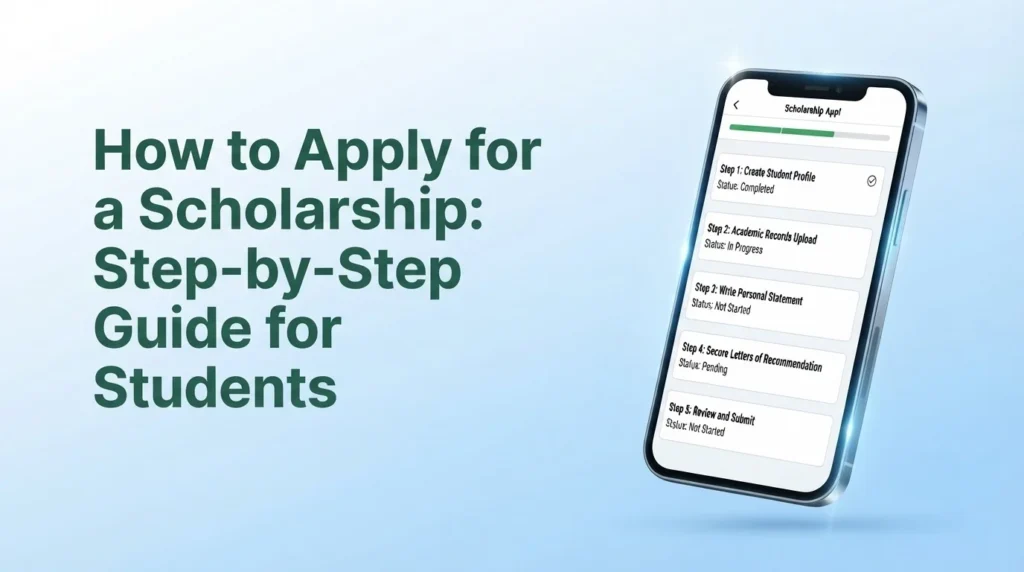
How to Apply for a Scholarship: Step-by-Step Guide for Students
 Student Guides
How to Study with Past Questions in University
 Student Guides
Freshers’ First-Semester Checklist: What to Do Before Lectures Get Busy
 Student Guides
Scholarship Application Documents Students May Need
 Student Guides
How to Email a Lecturer in a Nigerian University: Examples and Etiquette
 Student Guides
How to Find and Apply for Student Grants
 Student Guides
How to Prepare for University Exams
 Student Guides
How to Create a Study Timetable for University Students
 Student Guides
How to Take Lecture Notes at University
 Student Guides
University Student Budget in Nigeria: How to Plan Monthly Expenses Without Guessing
