

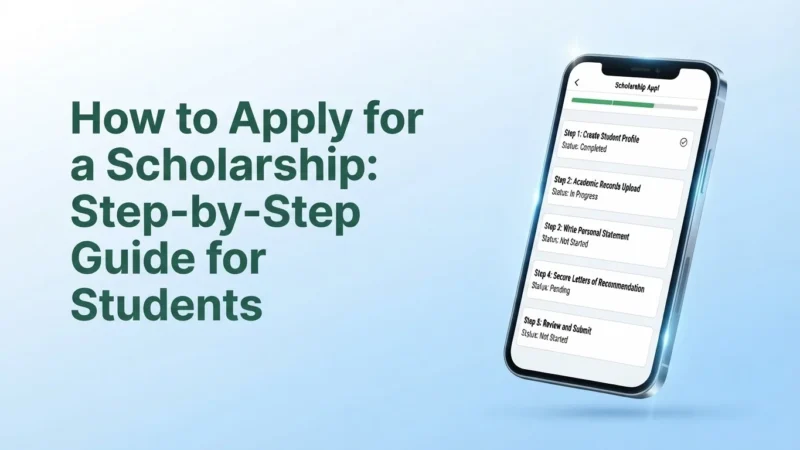
Learning how to apply for a scholarship is easier when you treat the process as a series of simple checks. First, confirm that you are eligible. Then gather your documents, prepare your answers, follow the provider’s instructions and submit before the stated deadline.
The exact process differs from one scholarship to another. A Nigerian student applying for a local award may face different requirements from someone applying for an international postgraduate scholarship. Always use the scholarship provider’s current instructions as the final authority.
1. Find a scholarship that matches your profile
When learning how to apply for a scholarship, start with opportunities that match your education level, course, nationality and goals.
Before preparing an application, check whether the scholarship actually fits you. Look at the study level, nationality, course or field, academic requirements, location and any other conditions listed by the provider.
Do not apply simply because the award amount looks attractive. A good match can save you time and help you prepare a stronger application.
For Nigerian students, useful starting points include official government scholarship information, universities, recognised organisations and established scholarship providers. The Federal Scholarship Board is part of Nigeria’s Federal Ministry of Education and handles federal scholarship and fellowship programmes. Check its current announcements before relying on information shared elsewhere. Federal Scholarship Board
2. Read the eligibility requirements carefully
Eligibility is usually the first major screening point. Read the full requirements before you begin the form.
Check items such as:
- Nationality or country of residence
- Age limits, where applicable
- Current academic level
- Minimum grades or academic results
- Course or subject requirements
- Work experience requirements for some postgraduate awards
- Admission status, where required
- Language requirements
- Any country, institution or programme restrictions
Requirements can change between application cycles. For example, official Federal Scholarship Board announcements can specify particular academic certificates, references, translations, interviews or other documents for a particular programme. Do not assume that requirements from an older scholarship cycle still apply.
3. Check what the scholarship actually covers
A scholarship can cover some education costs without covering every expense. Read the funding section before you make plans.
Depending on the award, support may include tuition, a living allowance, accommodation, travel, insurance, books or other approved costs. Some awards cover only selected expenses, while others require the student to pay for costs such as flights, accommodation or living expenses.
Do not use the phrase “fully funded” as a substitute for reading the funding terms. The provider’s official description should tell you what is included and what remains your responsibility.
4. Check the official application instructions
Next, follow the exact process given by the scholarship provider. This is one of the most important parts of how to apply for a scholarship successfully.
Once you find a suitable scholarship, go to the provider’s official website or the application portal identified by the provider.
Read the instructions from beginning to end before entering information. Check:
- How the application is submitted
- Which documents must be uploaded
- Whether documents need specific formats or translations
- Whether references are required
- Whether essays or personal statements are required
- Whether an admission offer is needed
- The closing date and time
- How applicants will be contacted
Federal Student Aid similarly advises students to read each scholarship’s requirements carefully, complete the application and meet the deadline. Its guidance also recommends starting early and keeping application materials organised. Federal Student Aid scholarship tips
5. Create a scholarship application checklist
Before you start filling out the form, make a simple checklist. This reduces the chance of forgetting a document or missing an instruction.
Your checklist can include:
- Scholarship name
- Official application link
- Eligibility confirmed
- Application deadline
- Academic documents
- Identification documents, if required
- Personal statement or essay
- CV or résumé, if required
- Reference or recommendation requirements
- Proof of admission, if required
- Additional forms or declarations
- Final submission confirmation
Keep a separate folder for each serious application. Give files clear names and keep copies of everything you submit.
6. Prepare your documents early
Some scholarship applications can be completed quickly, but supporting documents may take much longer to obtain.
Depending on the scholarship, you may need academic certificates, transcripts, identification, admission documents, references, a CV, a personal statement or other evidence. International applications may also request certified copies, translations or specific document formats.
Do not wait until the final day to ask a referee for a recommendation. If a document has to be requested from a school, examination body or other institution, allow enough time for the request to be processed.
7. Write the personal statement or scholarship essay carefully
If the application asks for an essay or personal statement, answer the actual question rather than writing a general biography.
A useful approach is to identify what the provider wants to learn about you. The prompt may ask about your academic goals, leadership, community involvement, career plans, challenges, achievements or reasons for choosing a particular programme.
Use specific examples. Explain what you did, what you learned and how the experience relates to the question. Keep your claims accurate and make sure the final response follows the word limit and formatting instructions.
Before submitting, read the answer again for clarity, spelling, names, dates and consistency. If possible, ask someone you trust to review it without changing your voice.
8. Arrange references before the deadline
If references are required, check who is eligible to recommend you and what the referee must submit.
Some providers ask for referee contact details during the application, while others require recommendation letters or online referee forms. Give your referee enough time and provide the information they need to understand the scholarship and your application.
Chevening, for example, states that applicants need two referees and provides specific instructions about references and supporting education documents. Its current application guidance also makes clear that submission follows the provider’s online application process. Chevening application guidance
9. Complete the application accurately
Enter your information exactly as requested. Check names, dates, grades, institution details, contact information and other important fields before you submit.
Do not exaggerate achievements or provide information that you cannot support. A scholarship application is not the place to guess when you are unsure about a fact. Check your records or ask the relevant institution instead.
If a question does not apply to you, follow the provider’s instructions for leaving it blank or marking it as not applicable. Do not enter random information simply to get through a required field.
10. Submit your scholarship application before the deadline
Do not plan to submit a scholarship application a few minutes before the closing time. Internet problems, portal errors, file-upload issues and missing documents can turn a finished application into a late application.
Try to finish your application early enough to review it calmly. Federal Student Aid also recommends submitting applications ahead of the deadline because application systems can experience heavy traffic close to closing times.
After submission, save the confirmation page, email or reference number if the provider supplies one. Keep a record of the date you submitted the application.
11. Check your application status
Submission does not always mean the process is finished. Some scholarships require screening, interviews, additional documents, tests or further verification.
Monitor the email address and application portal you used. Check your spam or junk folder as well, especially if the provider says it will contact shortlisted applicants by email.
If the provider gives you a way to check your application status, use the official portal rather than relying on messages from unofficial accounts.
12. Be careful with scholarship scams
A scholarship application should not require you to ignore basic safety checks. Be cautious when someone promises guaranteed funding, pressures you to pay immediately or asks for sensitive information through an unofficial channel.
Verify the opportunity through the scholarship provider’s official website. Compare the name of the programme, application deadline and application instructions with the information you received.
For more practical checks, read our guide on how to find legitimate scholarships online and avoid scams.
Common scholarship application mistakes
- Applying without checking eligibility
- Using an old deadline from a previous application cycle
- Ignoring the official application instructions
- Submitting incomplete documents
- Writing an essay that does not answer the question
- Exceeding the stated word limit
- Waiting until the last hour to submit
- Failing to keep copies of submitted documents
- Relying only on social media posts instead of the provider’s official source
- Paying an unofficial person to “guarantee” selection
Scholarship application checklist
Use this final checklist when you apply for a scholarship. It can help you catch small errors before submission.
Before you click submit, ask yourself:
- Do I meet every important eligibility requirement?
- Have I read the current application instructions?
- Am I using the official application page?
- Have I prepared every required document?
- Have I checked the essay or personal statement against the prompt?
- Have my referees completed what they need to do?
- Have I checked the deadline and submission time?
- Have I reviewed all information for errors?
- Have I saved a copy of the application?
What to do after applying
Keep your records until the scholarship process is complete. If you are shortlisted, you may need the same documents again for an interview or verification stage.
If you receive an award, read the provider’s instructions carefully before accepting it. Check the funding conditions, payment arrangements, academic requirements and any obligations attached to the award.
Frequently asked questions
Can I apply for more than one scholarship?
Yes, you can generally apply for multiple scholarships when you meet their eligibility requirements. However, read each provider’s rules because some awards may have restrictions on holding other funding at the same time.
Should I apply if I do not meet one requirement?
If a requirement is clearly mandatory and you do not meet it, applying is unlikely to help. Focus your time on scholarships where your qualifications match the stated criteria.
What documents should I prepare first?
Start with documents that may take time to obtain, such as academic records, recommendation letters, admission documents or certified copies. Then prepare application-specific materials such as essays and forms.
Is a scholarship application always free?
Not every education-related application process has the same fee rules, so check the provider’s official instructions. Be especially cautious if someone asks for money outside the provider’s stated process or claims that payment will guarantee selection.
Where can Nigerian students find scholarship information?
Start with official government agencies, universities, recognised scholarship providers and established organisations. The Federal Scholarship Board is an important official source for Nigerian government scholarship and fellowship information. You can also use the MyEducator Scholarships & Funding hub for related guides, then verify current opportunities with the original provider.
Final advice
A strong scholarship application is usually the result of careful preparation, accurate information and following instructions. Do not rush because an opportunity looks urgent. Check the provider, confirm the current requirements, prepare your documents and submit with enough time for a final review.
Scholarship rules and deadlines can change between application cycles. Always verify current details on the official provider’s website before you submit an application or make financial plans.
Sources: Federal Student Aid scholarship tips, Federal Student Aid scholarship information, Federal Scholarship Board, Federal Ministry of Education, and Chevening application guidance.
 Student Guides
How to Write an Academic CV for Scholarships and Graduate Study
 Student Guides
How to Find Legitimate Scholarships Online and Avoid Scams
 Student Guides
How to Study with Past Questions in University
 Student Guides
How to Email a Lecturer in a Nigerian University: Examples and Etiquette
 Student Guides
Freshers’ First-Semester Checklist: What to Do Before Lectures Get Busy
 Student Guides
How to Prepare for University Exams
 Student Guides
Scholarship Application Documents Students May Need
 Student Guides
How to Find and Apply for Student Grants
 Student Guides
How to Write a Scholarship Personal Statement
 Student Guides
How to Calculate CGPA in Nigerian Universities
